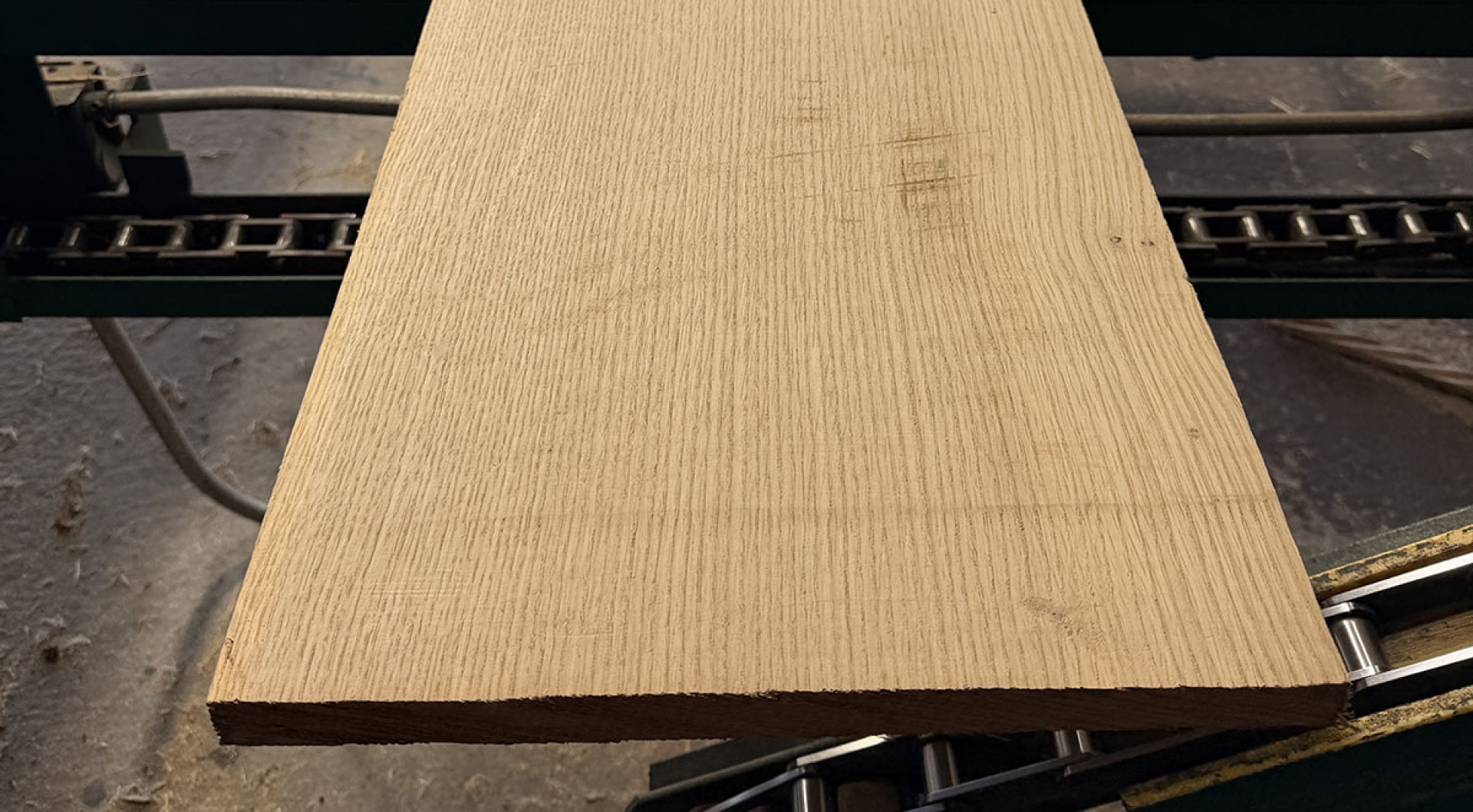
What is Rift and Quartered White Oak
Rift and quartered white oak refers to a method of sawing logs that produces highly stable lumber with a distinctive straight grain pattern. The wood comes from the species Quercus alba, a hardwood native to the eastern United States and widely used for furniture, cabinetry, flooring, and architectural millwork. Unlike plain-sawn lumber, rift and quartered white oak is cut in a way that aligns the grain more vertically through the board, creating a uniform appearance and improving dimensional stability.
Quarter Sawn White Oak
Quarter sawn white oak is produced by cutting a log into quarters and then sawing boards perpendicular to the growth rings. This process creates boards with growth rings typically running between 60 and 90 degrees to the face of the board. One of the most recognizable characteristics of quarter-sawn white oak is the presence of medullary ray fleck light, ribbon-like patterns that appear across the grain.
These rays are part of the tree’s natural structure and become visible when the log is cut in this orientation, giving quartered white oak a decorative figure that is highly valued in fine woodworking.
Rift Sawn White Oak
Rift sawn white oak, on the other hand, is cut so that the growth rings meet the face of the board at roughly 30 to 60 degrees. This technique minimizes the appearance of ray fleck and produces an extremely straight, consistent grain pattern across the board. Rift sawn lumber is often selected when a clean, linear look is desired, such as in modern cabinetry or high-end furniture where uniform grain is important.
Because both rift and quarter-sawn boards are cut with the grain running more vertically, they tend to move less with seasonal humidity changes compared to flat-sawn lumber. This improved stability helps reduce issues like cupping and twisting, which is why rift and quartered white oak is commonly specified for applications where precision and long-term performance matter, including flooring, cabinetry, doors, and architectural paneling.
Benefits of Rift and Quartered White Oak for Flooring
1. Rift And Quartered White Oak Is Distinctive
While there are a variety of different cuts of oak for flooring, rift and quartered white oak is very distinctive aesthetically. The straight, uniform grain patterns and ray flecks between the two custs showcase the beauty of white oak. This is visually striking and creates a premium look. Because of these visual characteristics, rift and quartered white oak is suitable for both traditional and modern interior design styles.
2. Rift and Quartered White Oak Has Superior Durability and Wear Resistance
White oak is a very dense, durable hardwood that has a Janka hardness rating of 1,360 lbf. It is one of the hardest readily available hardwoods, sitting behind hard maple and hickory. This level of hardness means that it is highly resistant to dents, scratches, and moisture due to its closed cellular structure. It also contains high levels of tannins, making it very resistant to rot and fungi.
Because of the rift and quartered white oaks' durability, it performs well in high-traffic residential and commercial environments. It is also fairly cost-effective considering how durable it is.
3. Rift and Quartered White Oak is Efficent When Used in High-End Flooring Manufacturing
Rift and quartered white oak is used in high-end flooring because the vertical grain orientation behaves very predictably during drying, milling, and finishing. Compared to flat-sawn lumber, rift and quartered boards tend to be flatter and more stable throughout manufacturing.
This stability is particularly important when flooring is milled with tighter tolerances found in high-end applications. Tongue-and-groove flooring systems require boards that maintain consistent width and thickness so that they lock together properly during installation. Lumber that moves excessively during kiln drying or planing can lead to dimensional inconsistencies, which may cause gaps or uneven surfaces in the finished floor.
Rift and quartered white oak provides several advantages that make it best suited for flooring production:
- Greater dimensional stability: Vertical grain boards are less likely to cup, twist, or distort during drying and milling.
- More consistent grain patterns: The straight grain created by rift sawing and the distinctive ray patterns from quarter sawing produce a more uniform appearance across flooring runs.
- Improved machining performance: Stable boards move more smoothly through planers, molders, and flooring machines, helping mills maintain precise dimensions.
- Reduced waste during production: Because boards remain flatter and more consistent, manufacturers can achieve better yields when producing finished flooring.
Choose Rift and Quartered White Oak from Church and Church Lumber Company for Your Next Flooring Project
Builders, architects, and interior designers often specify rift and quartered white oak flooring because it offers a balance of durability, cost effectiveness, and a refined aesthetic. Flooring is a long-term component of a residential or commercial project, and selecting premium lumber that looks great and is durable helps reduce the need for replacement or repair.
If you are looking for a supplier for the finest quality rift and quartered white oak, look no further than Church and Church Lumber Company. Contact us today to learn more about how we can help you source rift and quartered white oak for your next flooring project.