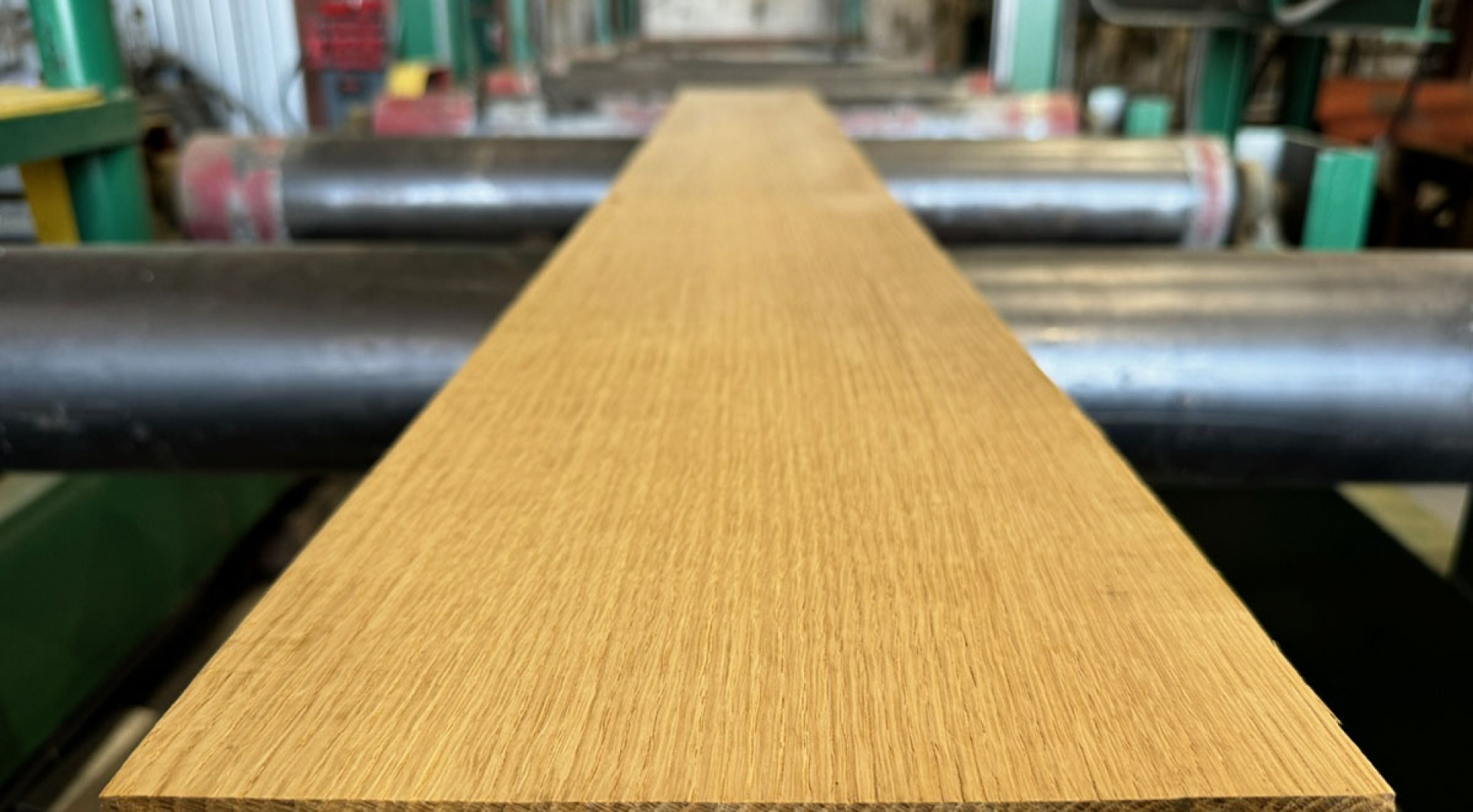
How Rift And Quartered White Oak Milling Works
Sawmills can saw hardwoods in several patterns, but rift and quartered milling requires careful log selection, calculated breakdown, and controlled sawing. This approach maximizes vertical grain, minimizes tangential movement, and produces boards that hold shape over time.
Log Selection for Rift and Quartered White Oak
White oak logs are not interchangeable. Correct selection determines the quality of the final lumber, and our team evaluates each log with several factors in mind:
- Diameter: Larger logs allow for cleaner quartered cuts and better yield.
- Straightness: Straight logs reduce complications during sawing and improve overall consistency.
- Growth Ring Orientation: Logs with tighter, more even growth patterns produce the best vertical grain.
- Health and Integrity: Solid logs with minimal defects allow the quartered pattern to shine without excessive sorting.
By choosing logs carefully on the front end, our mill begins with material that is suited for the precision required in rift and quartered production.
The Quartering Step
To begin the milling process, each log is sawn into quarters. Dividing the log creates four wedge-shaped pieces that position the growth rings nearly perpendicular to the face of the boards that will be sawn from them.
This step is essential. The orientation created during quartering is what produces the signature look and performance characteristics of rift and quartered lumber.
Sawing for Vertical Grain
Once the log is quartered, each quarter section is placed on the saw carriage. Boards are then sawn in a manner that keeps the annual growth rings angled between 45 and 90 degrees relative to the board face. This creates the vertical grain pattern that reduces movement and enhances long-term stability.
Two results occur during this phase:
- Quarter Sawn Boards: These boards show the ray fleck pattern that many craftspeople prize. They display dramatic medullary rays across the grain and deliver outstanding dimensional stability.
- Rift Sawn Boards: Rift boards show a straight, clean grain pattern without the ray fleck figure. They are ideal for modern designs, tight joinery, and applications where subtle grain movement is desired.
Both types emerge from the same quartering process but offer different aesthetic and structural advantages.
Why Rift And Quartered White Oak Matters for Performance and Appearance
Rift and quartered white oak is chosen intentionally. Its milling method directly influences how the lumber behaves once it is installed in a home, placed in a piece of furniture, or built into an architectural feature.
Rift and Quartering Improves Stability
Wood moves as humidity changes. Flat sawn boards tend to cup or distort more easily because their grain is oriented in a wider arc. Rift and quartered boards, by contrast, move less because the grain runs vertically. This simple shift in orientation reduces stress across the board, giving the lumber greater long-term stability.
This stability matters for:
- Flooring installations: Boards stay flatter, and joints remain tighter.
- Cabinet frames and doors: Components resist warping better over years of seasonal changes.
- Architectural trim and paneling: Longer runs remain straight and true.
Rift and Quartering Strength and Structural Integrity
White oak is naturally strong, but rift and quartering it further strengthen it. Because the grain runs vertically, the board resists bending and twisting more effectively than flat-sawn material. This strength benefits craftsmen who demand predictable behavior in their tools and projects.
Applications where this matters most:
- Tables and chairs: Tight joinery requires wood that stays true.
- Millwork: Built-ins and moldings need long-term stability.
- Stair parts: Treads and newels benefit from reduced seasonal movement.
Ray Fleck Figure And Vertical Grain Appearance
One of the distinguishing visual features of quarter-sawn white oak is its ray fleck. These medullary rays show up as shimmering, ribbon-like patterns across the board surface. This figure is a major reason the style is popular in Mission, Craftsman, and Arts and Crafts furniture.
Rift sawn boards, on the other hand, offer a clean vertical grain without visible fleck. This gives designers a choice based on project needs:
- Quarter sawn: Distinctive figure, traditional character.
- Rift sawn: Straight grain, modern, and clean aesthetic.
Rift and quartered flooring is known for improved wear performance. Because of the grain orientation, the surface holds up well under foot traffic and maintains its appearance longer than flat-sawn flooring. This makes it a preferred choice for high-traffic commercial environments as well as residential living areas.
Key Advantages Of Rift And Quartered White Oak
Below is a clear overview of the benefits that consistently set rift and quartered material apart:
- Stability: Reduced movement across the board because of vertical grain.
- Strength: Grain alignment improves overall structural performance.
- Clean or Figured Appearance: Choice between rift straight grain and quartered ray fleck.
- Improved Wear: Excellent for flooring and heavy use applications.
- Consistency: Changing humidity impacts this cut less than other sawing methods.
- Versatility: Works for furniture, flooring, cabinetry, trim, and architectural design.
- Premium Yield: Even though more labor is required, the end product delivers long-term value.
How We Maintain Quality Throughout The Manufacturing Process
Producing rift and quartered white oak requires careful handling at every step. Our mill manages this through a system that prioritizes accuracy, grading discipline, and moisture control.
Breakdown And Grading
Boards are separated by grain angle and fleck visibility to ensure customers receive the exact appearance they require. Our graders understand the difference between flooring grade, furniture grade, and architectural grade, and each piece is sorted accordingly.
Targeted Drying Schedules
White oak is known for its closed-cell structure, which slows moisture movement. Drying schedules must be adjusted so the lumber dries evenly. Our kiln operators follow calibrated, species-specific programs that support stability and reduce the risk of case hardening or internal stress.
Consistent Thickness And Surfacing
Final surfacing ensures customers receive boards that are uniform and ready for further milling. This consistency supports smoother installation, cleaner machining, and more accurate joinery.
Why Rift And Quartered White Oak is Important
Architects, designers, and builders continue to specify rift and quartered white oak because it performs well under real-world conditions. In both residential and commercial environments, this cut holds shape, provides visual appeal, and stands up to long-term wear.
Here are a few ways professionals rely on the material today:
- Architectural Millwork: Straight grain supports clean lines in contemporary environments while quartered fleck highlights traditional craftsmanship.
- Custom Furniture: Chairs, tables, and casework stay stable across seasons.
- Flooring Installations: Vertical grain minimizes cupping and supports a long service life.
- Cabinetry: Panels and frames maintain shape with fewer long-term changes.
- Stair Components: Vertical grain reduces twisting under load.
Modern woodworking continues to evolve, but rift and quartered white oak remains one of the most reliable options for projects that require both beauty and long-term performance.
Beyond these core uses, many specifiers choose rift and quartered white oak for large commercial projects where uniformity is critical. Hotels, office buildings, libraries, and academic spaces frequently rely on this material because it maintains its shape in climate-controlled environments and continues to perform even when humidity shifts occur due to daily traffic.
Whether the lumber is being routed, profiled, shaped, or turned, rift-and-quartered white oak responds predictably. Tear-out is reduced, and edges remain sharp, allowing craftsmen to achieve precise details in trim, casework, and furniture components. This consistency reduces material waste and shortens production time, creating efficiency for both small shops and larger manufacturing operations.
Choose Us for Your Rift And Quartered White Oak
Rift and quartered white oak delivers stability, strength, and a visually consistent grain pattern that outperforms most flat sawn options. The process required to mill it correctly ensures that each board is sturdy and reliable for furniture, flooring, cabinetry, and architectural wood applications.
Our team mills rift and quartered white oak with precision from log selection through final surfacing. We supply this material throughout our region, nationally, and internationally. If you need dependable, high-quality rift and quartered white oak for any project, we are ready to help. Reach out to us for more information about rift and quartered white oak.