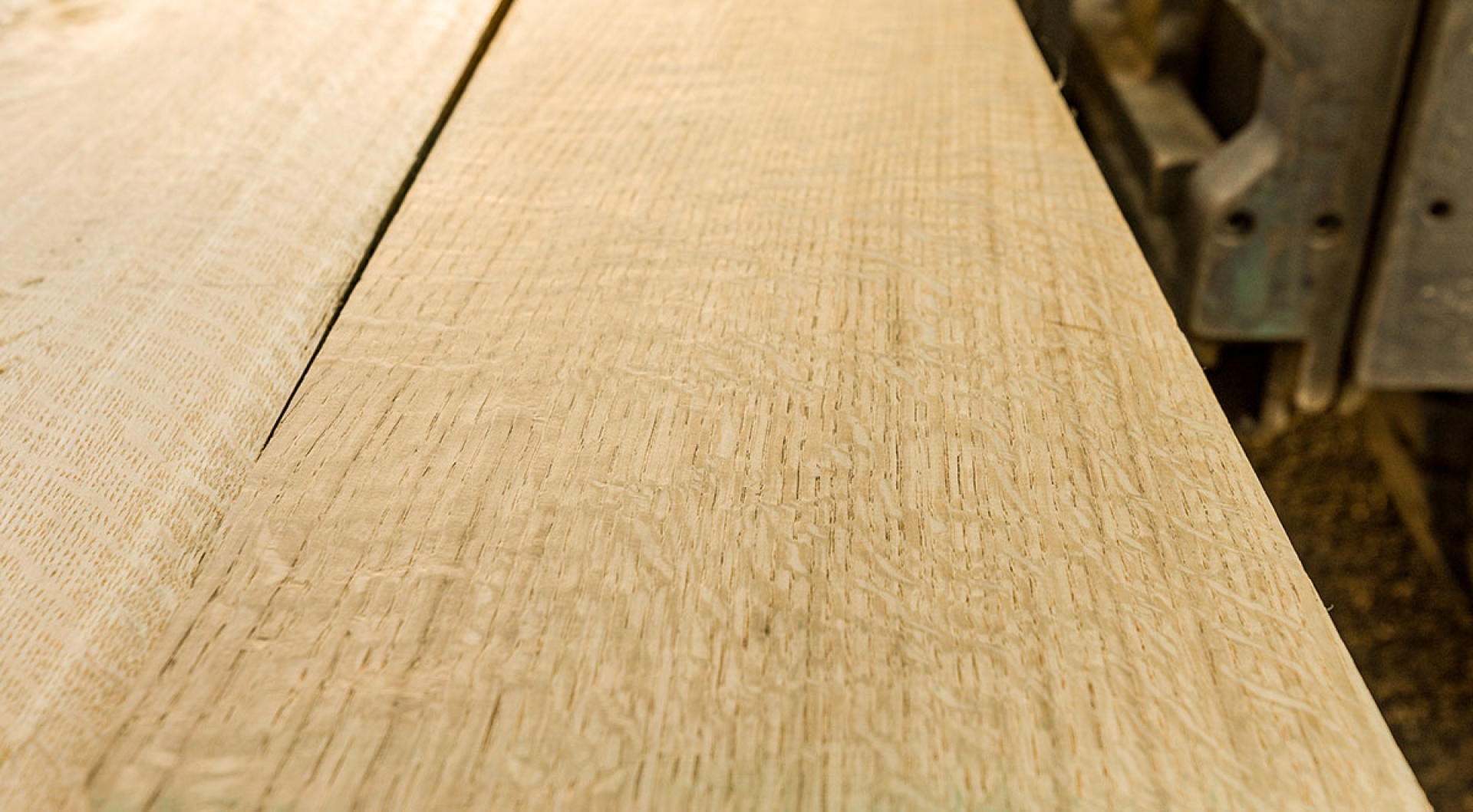
What Is Rift and Quartered White Oak?
White oak is one of the most sought-after hardwoods in North America and has long been valued for its strength, durability, and versatility. The term "white oak" refers to several hardwood species within the Quercus genus, with Quercus alba being the most common.
Native to the eastern United States and abundant throughout the Appalachian Mountains, white oak has earned a reputation as a premium hardwood for everything from fine furniture and flooring to architectural millwork and commercial construction.
One of white oak's greatest advantages is its natural durability. Its closed cellular structure prevents moisture from penetrating the wood as easily as many other hardwood species, making it well-suited for applications where humidity and water resistance are important.
This characteristic has made white oak a trusted material for centuries in shipbuilding, barrel production, exterior joinery, and other demanding environments. It also machines cleanly, accepts stains and finishes exceptionally well, and performs reliably throughout the milling process.
Rift and Quarter Sawn Lumber
Among the different ways white oak can be milled, rift and quarter-sawn lumber is widely considered the highest-quality option for projects that demand both performance and appearance. Rather than cutting boards tangentially through the log like plain-sawn lumber, rift and quarter sawing methods follow specific angles in relation to the growth rings.
While these techniques require more time and produce fewer boards from each log, they create lumber with superior stability and a distinctive grain pattern that is highly desirable for premium woodworking applications.
Quarter sawn white oak is milled by dividing the log into quarters before sawing each section so the growth rings run nearly perpendicular to the face of the board. This method produces the beautiful ray fleck figure that has become a signature feature of quarter-sawn white oak. Rift sawn white oak is cut at a more consistent angle, typically between 30 and 60 degrees to the growth rings—which minimizes ray fleck and creates a clean, straight, uniform grain that is especially popular in contemporary cabinetry and architectural design.
Beyond their visual appeal, both rift and quartered white oak offer exceptional dimensional stability. Because the grain runs more vertically through the board, the lumber experiences significantly less expansion, contraction, cupping, and twisting as humidity changes. This makes it an outstanding choice for precision applications such as custom cabinetry, architectural millwork, hardwood flooring, furniture, doors, and other projects where long-term performance is just as important as appearance.
Application 1: Custom Kitchen Cabinets
The focal point of most kitchens is the cabinetry, which should be sturdy and distinctive. White wood with rifts and quarters is ideal for high-end cabinets in bathrooms and kitchens where consistent grain and little movement are essential.
Additionally, because of all the water needed for cooking and washing, cabinets are frequently located in areas with higher moisture content. Similarly, bathrooms may have higher humidity than the rest of the house. Rift and quartered white oak boards may be more durable than other hardwoods due to the closed cellular structure of white oak.
Application 2: High-End Furniture
When it comes to selecting wood and milling techniques, furniture manufacturing is a completely different animal. In the upscale market, furniture must not only be durable but also aesthetically beautiful and made of classic materials. In addition to being classic, rift and quarter-sawn white oak's flecks and patterns provide personality without taking away from the designer's creative vision.
Application 3: Architectural Millwork
Precision-cut lumber that is both aesthetically pleasing and able to withstand the rigors of daily use is essential for millwork. Since people frequently focus on the specifics of any architectural "brush stroke" performed in a project, architectural millwork is particularly significant. For trim, paneling, and interior finishing that needs a uniform appearance across broad areas, rift and quartered white oak is perfect.
Application 4: Hardwood Flooring
For good reason, rift and quartered white oak is one of the most popular flooring materials. Most, if not all, of the rift and quartered white oak boards have the same appearance. It is also quite durable and resilient. This is helpful in busy regions near residences or commercial buildings.
Application 5: Luxury Trim Work and Paneling
Due to its classic appearance and durability in architectural elements surrounding a house or place of business, rift and quartered white oak is frequently utilized in luxury trim and wall paneling. Additionally, it resists paint and stains effectively. For house designers who want to add some flair to their walls, this wood product is ideal.
Why Rift and Quartered White Oak Performs So Well
Rift and quartered white oak is the perfect wood product when it comes to reliability and performance in high-end applications such as the ones in this list. For one, it is often more affordable than other luxury hardwoods, but due to its milling, it performs well and is aesthetically pleasing.
Its performance is due to its:
- Closed cellular structure
- Moisture resistance
- Excellent machining characteristics
- Superior finishing qualities
- Long service life
All in all, rift and quartered white oak is a great choice for your next luxury project!
Church and Church Lumber Company - The Source for Rift and Quartered White Oak
Church and Church Lumber Company and its family of wood products businesses are the premier provider of Appalachian hardwoods sourced from Western North Carolina, Southwest Virginia, and beyond. In addition to rough sawn lumber, Church and Church offers high-end rift and quartered white oak through their Select Hardwoods division. To learn more about some of the top-end hardwood products available, check out the Select Harvest Product page or contact us today!